
Who this is for
Families who eat outside, people with a pool deck or fire pit area, grillers who cook after dark, hosts who want the patio usable after 9 p.m., and anyone with stairs, a sloped walk or a step down to the yard. It is also a smart add when an older relative visits often and the back steps are dark.
Signs you need better light where you walk
- People use phone flashlights to get from the drive to the door.
- The deck stairs are one dark shape at night.
- The patio has a single wall pack that blinds whoever sits facing it.
- String lights from a store sag, flicker or die after one summer.
Fixture types for the places people walk and sit
Path lights
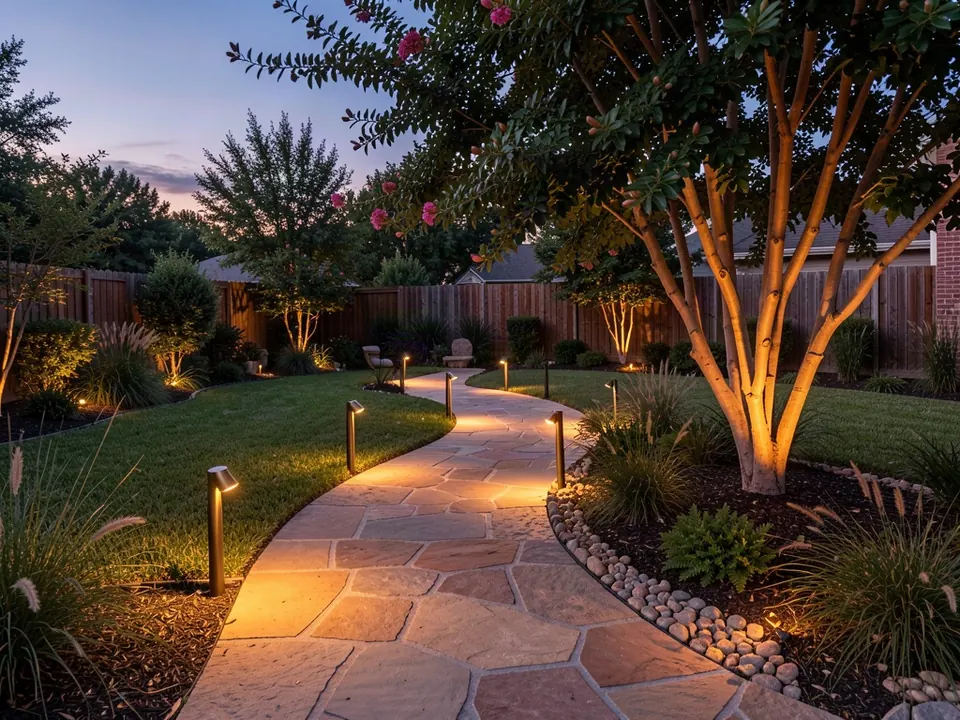
Short posts with a cap that throws light down and out. Space them so pools of light overlap a little instead of forming a runway. Fewer, better aimed fixtures look calmer than a row of them every few feet.
Step and riser lights
Small, low-glare lights set into the face of a step or the side wall of a stair. They light the tread, not your eyes.
Deck and rail lights
Low fixtures under rail caps or on posts outline the deck edge and the way down.
Patio string lights
Bistro strings on cable or poles over the seating area. Pros use stronger hardware than a kit, plus a dedicated outdoor outlet when needed. The Department of Energy says LED products work well outdoors and names pathway, step and porch lights as good uses.
The five-step process
- Walk the routes. The pro traces how people move: drive to door, back door to patio, patio to yard.
- Choose fixtures and spacing. Path, step, rail or string, based on the surface and how bright it needs to be.
- Plan power. Low-voltage pieces run from a transformer. Plug-in strings need an outdoor GFCI outlet, and a new outlet is work for a licensed electrician.
- Install. Path lights get staked and cabled. Step lights may mean cutting into wood or masonry, so ask how it is sealed.
- Set controls and test. Photocell, timer or app, then a nighttime walk of every route.
Patio and pathway lighting cost
National ranges reported by cost guides. The pro's on-site quote is what counts.
| Item | Range reported | Source |
|---|---|---|
| Path light, installed | $50 to $150 | HomeGuide |
| Patio string lights, installed | $50 to $150 | HomeGuide |
| String lights, per fixture | $50 to $200 | Angi |
| Porch light, installed | $50 to $250 | HomeGuide |
| Lamp post or bollard, installed | $200 to $800 | HomeGuide |
| GFCI outlet, installed | $150 to $350 | HomeGuide |
Step and rail lights are usually priced inside the overall system quote, so ask for them as separate lines. For more on how quotes are built, see outdoor lighting cost.
Who is licensed for what
The TDLR list of licensing exemptions covers landscapers doing electrical work on low-voltage exterior lighting, power sources excluded. So low-voltage path and step lights can be a lighting pro's job, but the outdoor outlet or circuit behind them is electrical work. Pole-mounted strings that plug into an existing outlet usually need no new wiring at all.
What to ask before you hire
- Will path lights be spaced for even light or for looks? Can I see both?
- How are step lights sealed against water in wood or stone?
- Are the string light poles anchored in concrete or in sleeves?
- Do you add the GFCI outlet, or does a licensed electrician?
- Can the patio and the path run on separate timers?
Many people pair this with tree and bed lights from landscape lighting, or with seasonal roofline work through Christmas light installation.
Areas we cover for patio and pathway lighting
Outdoor lighting questions
How far apart should path lights be?
It depends on the fixture's spread and how bright you want the walk. The aim is overlapping pools of light without a runway look. Ask the pro to set a few temporarily so you can judge after dark.
Are solar path lights worth it?
They are cheap and need no wiring, and Angi lists solar fixtures at $50 to $200. Output and run time depend on daily sun, so shaded walks often do better with low-voltage wired lights.
Can string lights stay up all year?
Yes, if they are rated for outdoor use and hung on proper cable or poles. Check the strand for an outdoor rating and plug it into a GFCI-protected outlet.
Do step lights need a separate transformer?
Not usually. Low-voltage step lights can often share a transformer with path and landscape lights if the load allows. The pro adds up the total before choosing the size.